Poland has approximately 3,654 kilometres of inland waterways designated for navigation. Of this total, around 2,078 kilometres are classified as navigable, meaning they meet minimum depth and width parameters to support commercial freight movement. A much smaller portion — roughly 214 kilometres — currently carries any regular freight traffic. The gap between classified and actively used waterways reflects both infrastructure gaps and the dominance of road and rail in Polish logistics.
The CEMT Classification System
European inland waterways are classified according to the CEMT (Conférence Européenne des Ministres des Transports) scheme, which assigns classes I through VII based on channel dimensions and the size of vessels they can accommodate. Poland's waterways range from Class I (small rivers, minimum 1.2 m depth) to Class Va at the Gliwice Canal and the Odra section between Szczecin and Kostrzyn.
Class Va waterways permit barges up to 110 metres in length, 11.4 metres in beam, and 2.8 metres in draught, with a maximum cargo capacity of approximately 1,500 tonnes per single hull. Class Va is considered the minimum standard for economically viable commercial freight. Most of the Odra between Wrocław and Kostrzyn fluctuates between Class III and Class IV depending on water level.
According to GUS data, Poland transported 9.2 million tonnes of cargo by inland waterway in 2022 — a figure that has remained broadly flat for a decade, while Germany moved over 220 million tonnes on its waterways in the same year.
Lock Systems and Infrastructure
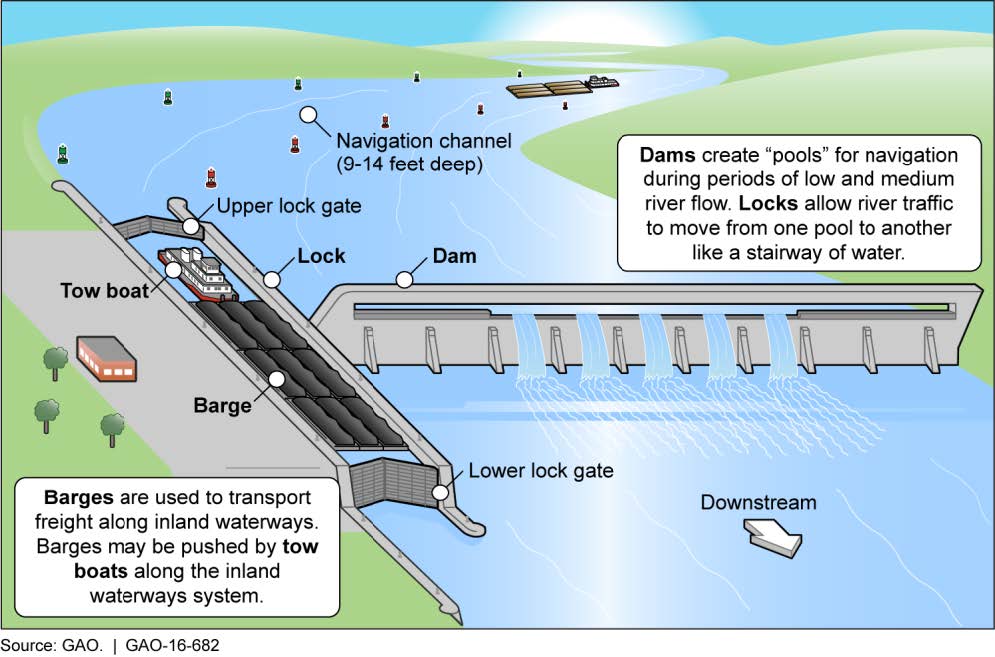
Commercial navigation on Polish rivers is regulated through a series of lock chambers maintained by the relevant RZGW (Regional Water Management Board). The Odra has 24 active navigation locks between Racibórz and the German border at Hohensaaten-Friedrichsthaler Wasserstraße. Lock chambers on the channelised Odra are mostly dimensioned for Class III to Class IV vessels — a limiting factor for the push-convoy configurations used in commercial freight.
The Vistula is largely unregulated below Warsaw. The Włocławek reservoir lock, completed in 1970, remains the only navigational lock on the lower Vistula, and its design preceded modern barging standards. Upstream of the lock, natural river conditions prevail with unpredictable shoals that shift seasonally.
The Bydgoszcz Waterway Junction links the Brda, Noteć, and Bydgoszcz Canal to form the only cross-basin connection between the Vistula and Odra systems. This route — known as the Waterway E70 in European designation — passes through 19 locks across the Bydgoszcz Canal and the Noteć canalised section. The E70 is navigable year-round but is restricted to vessels not exceeding 57 metres in length and 9 metres in beam on certain segments.
Seasonal Water Level Constraints
Water levels on the Vistula are highly seasonal. Minimum navigable depth of 1.6 metres is often not maintained during summer drought periods. Between July and September, barge operators on the lower Vistula routinely face closures or reduced cargo loading to stay within available draught. In contrast, spring snowmelt can temporarily raise river levels beyond safe navigation limits.
The Odra is more regulated due to its channelisation between Racibórz and Szczecin, but the middle section above Wrocław remains susceptible to low-water closures in dry years. The 2018 and 2022 droughts both resulted in multi-week navigation suspensions on the upper Odra, with operators rerouting cargo to road haulage at significant cost increase.
RZGW publishes real-time gauge readings for major Polish waterways through the national ISOK hydrological monitoring network. Operators are advised to check declared navigable depths at rzgw.gov.pl before dispatching cargo.
Barge Operations: Typical Configurations
Freight on Polish inland waterways is carried primarily in motor cargo vessels (Class IV–Va) and pushed convoys where a push-tug propels one or two unpowered barges. The most common configuration on the Odra is a single motor vessel of 800–1,200 tonnes capacity operating independently, as the lock dimensions on the middle Odra do not reliably accommodate full convoy formations.
Cargo types transported by barge in Poland include:
- Sand, gravel, and aggregates (largest volume category)
- Coal and lignite from Upper Silesian mines via the Gliwice Canal
- Steel coils and slabs from the Dąbrowa Górnicza area to Szczecin
- Agricultural commodities (grain) during harvest season on the lower Odra
- Containerised freight in limited volumes on the Szczecin–Wrocław run
EU Funding and Infrastructure Plans
The Polish government's Master Plan for Inland Waterway Transport, adopted in 2019, outlined investment targets for reaching Class Va parameters on the Odra by 2030 and beginning channelisation works on the lower Vistula. European funds from CEF (Connecting Europe Facility) have been allocated to feasibility studies for the E40 waterway corridor running from Gdańsk to Kyiv, though environmental impact reviews have raised concerns about sections crossing protected Natura 2000 areas in the Bug river valley.

